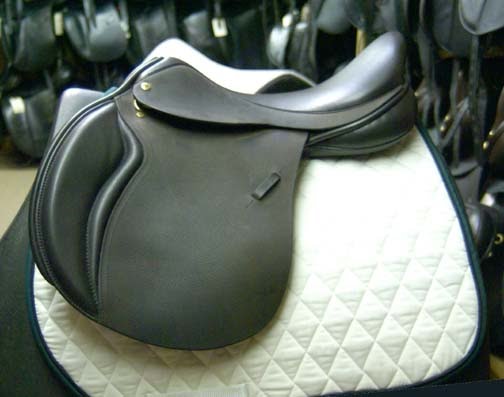
Saddle fitting templates can be a little like heiroglyphics: if you don't know how to read them, they won't make much sense. But unlike heiroglyphics, it doesn't require years of study to crack the code. At Trumbull Mtn. Tack, we do the bulk of our business long-distance, through the use of templates and photos, so being able to read a template and understand how it relates to the accompanying photos is a requirement. If you look at them as a whole, they can seem to be a whole bunch of unrelated lines ... but if you break each tracing down, it's pretty easy to decipher.
Let's take a look at an example:
The tracing marked #1 is taken 3 fingers' width behind the rear edge of the scapula. This tracing shows the tree width that the horse needs, and if any modifications are needed to the front of the panels, such as a full front gusset or wither gussets. In this case, wither gussets might be a good option, based on the "dips" in the tracing.
The #2 tracing gives an idea of the panel configuration needed. In this case, the panels will need a bit of angle - we're not looking at a real "roof" back here, but it's not entirely flat, either.
The topline tracing, at the bottom of the template, shows how much curve the tree will have to have, and shows if rear panel modifications may be needed. In this case, we're dealing with a good wither that's consdierably higher than the slightly "dippy" back, so we'll need a tree with some curve and a fairly generous rear gusset; there's a drop or 2 1/2" from the first tracing to the second.
So, if we start with tracing #1, the first thing we'll need to determine is tree width. There are a couple different ways of determining this. First is to use templates provided by the saddle companies. Here, we're comparing it with the Frank Baines medium:
The template is slightly narrower than the first tracing, so let's try a Baines med-wide template:
Almost perfect. There is that dip on the left side, but that can be dealt with either with flocking (if it's a long-standing issue that won't change) or a correction pad.
Just for giggles, let's see how this horse measures in the Black Country templates. Here's the medium template:
Almost perfect. Maybe just the tiniest bit narrow, but well within the acceptable parameters. Now, compared to the Black Country med-wide:
Again, just about perfect - perhaps a teeny bit wide, but again, definitely acceptable. And if you have to err one way or the other, wider is better than narrower, since you can add flock or use a thicker / correction pad.
Now, what if you don't have a saddle company's width templates, or what if the customer is looking for a used saddle? Here's the method we use. First, we get a "generic" reading by using the Wintec Gullet gauge:
To use it on a horse, you place the "legs" of the gauge in the spot where you'd take your first tracing (3 fingers' width behind the rear edge of the scapula, where the tree points ideally sit); the color indicated on the top left of the gauge will then tell you which gullet plate you'll need in the saddle.
Yellow is narrow, green is med-narrow, and so on.
When used on the tracing, it shows that it measures a medium-wide.
So we take the blue med-wide Wintec plate, and compare it to some different saddles. Keep in mind that the gullet plate dips in a bit on the legs rather than running straight, so you have to look at the overall angle of the leg and discount the dip.
Here's the gullet compared with a med-wide Black Country Wexford (angle of the tree point is shown in green in all the following photos):

This tree is a bit narrower than what we'd need - probably would have to go to a wide tree in this particular saddle.
Next is a medium-wide Baines Enduro LDR:
Too narrow again - another saddle where we'd probably go up to a wide tree.
Here's a medium-wide Black Country Celeste (built on a hoop tree).
The angle of the tree comes closer, but the full front gusset will make it fit less generously. (This horse isn't a good candidate for a hoop tree, but I wanted to toss this in just for comparison.) The full front gusset is often a good fitting option for a withery horse, but the change in fit is something to keep in mind.
Here's another med-wide hoop tree (a Black Country Eloquence X this time):
This is very close to perfect ... IF the horse were a hoop tree candidate!
Here's a med-wide Albion SLK:
NOW we've found a good candidate - at least in the width department.
Just for giggles, let's try a couple more. Here's a med-wide Black Country Vinici ...
... which looks like another winner.
And finally, here's a med. tree Passier Corona with Freedom panels:
Yet another good possibility, though the Freedom panels might provide a little too much room in the pommel arch (similar to the problem with the hoop tree).
Now that we've decided on tree width, let's look at rear panel configuration. There's a pretty wide variation in panel thickness, even among gusseted panels:
And since saddles are (for the most part) hand-crafted, there can be quite a lot of variation even in the same make and model. The gussets below are all on Frank Baines Caprioles:
Since this horse has about 3.5" of drop, the saddle will need to have a pretty generous rear gusset.
A plain panel (below) wouldn't begin to offer enough lift for the rear of the saddle:
Neither would a panel with a thin gusset:
You'd need a much thicker panel, like so:
Now, tree shape. We'll need something with some scoop and perhaps a high head to accommodate the big difference between back and wither.
This tree would be far too flat, and would bridge like a plank over a ditch:
As would this one:
This is closer:
As is this one:
Better yet:
But if I had to pull two off the rack - with no modifications - the two below would be my choices:
A Frank Baines Omni high head:
And an Albion SLK high head:
Both have a curved tree and a very generous rear panel, so - assuming the front panel configuration and tree width were correct, either of these would have a pretty good chance of working, based on the template.
Just one caveat here: the template and photos only show the horse at one static moment in time - and fitting a moving horse with a rider up can be a whole different story. Perhaps the horse lifts his back considerably when he starts to move, and the more curved trees tends to rock, or perhaps the rear gusset is a bit too thick, and makes the saddle sit pommel-low and jam in behind the horse's shoulders. That's why we offer the week trial period, and ask for so many photos. There may be one or two things you and your horse really like about a particular saddle, and one or two that you don't ... so sometimes we work through the process of elimination, trying this or that before we find the saddle with the right combination of everything for you and your horse.