Saturday, December 31, 2011

Random End of Year Stuff

Writing is a very organic and uncertain activity.  You start out with a specific story in mind, but half-way through, you find that the story (or post, or article) has gone haring off on its own down a path that you never meant to walk.  Sometimes those bits of writing get shelved and pulled out later (I have quite a few of those), sometimes you hit the "delete" button, and sometimes you follow the path just to see where it will lead.  This blog has turned out to be one of those "follow the path" things.

When I started this blog, it was something of an experiment in using social media as "free advertising" for the tack shop.  It's worked pretty well - turns out that it's consistently one of the top portals to the shop's website.  It's also grown into something more, though.  I truly enjoy writing it, and it's been received far better than I'd ever expected.  It's given me a chance to get some education about saddle fitting to the general horse public, it's allowed me to give a leg-up to some friends and colleagues, and it's given me an outlet for the frustration and silliness I encounter on a regular basis.  It's also led me to being asked to write articles and do interviews ... which I find amazing.  Who'da thunk a cranky half-a-century-old saddlefitting broad living in the booniewhacks of VT would have input and info that the general horse public would find interesting?!  It's all very, very cool, and I thank each and every one of you from the heart.

Given that this is the last day of 2011, I thought it might be fun to throw out some random things.  Two are flat-out brags, and the rest are things that never seemed to quite fit into any specific post.  First, I'm going to get the brags over with.

Here's the cover of the TrailBlazer magazine that features my "To Shim or Not To Shim" article:

All glossy and shiny and makes me go "wooooooo ...."

The frontspiece of the article:


Byline and everything!!!
__________________________________________________________________________________

Second brag.  I have been invited to the London opening of the movie War Horse:


This is thanks to Nikki Newcombe, the former Sales Manager at Black Country Saddles.  She's started her own saddle company, Bliss of London (which will be featured here as soon as they're ready to launch), and very kindly invited me.  Don't I wish!!!
__________________________________________________________________________________

My work space at the shop is a bit on the cold side.  We're up on top of a barn, and the walls in my office are NOT well-insulated.  I do tend to like lower temps (when people remark on the chilliness, I tell them that old meat needs to be refrigerated) and dress in layers to help deal with the occasional hot flash ... so the outer layer in the winter months is almost always polar fleece.  It's warm, it's lightweight, it breathes ... and it's probably not the smartest choice for someone who plays with sheep fur (or at least navy blue polar fleece when the sheep fur is white):


__________________________________________________________________________________

Got a six year old saddle in last week for a strip flock.  Not only was it incredibly dirty (I mean, you really need to work to get dirt jockeys on the panels), it had never had the flocking touched, and it had been ridden in jeans.  Here's what happens to your saddle's seat when your ride in jeans:


Close-up view.  The hair-side finish has been worn completely away and you can see the skin side.  A year or so more of riding in jeans, and the saddle's owner will be looking at a $600 re-seat.


__________________________________________________________________________________

When you flock a saddle, you tend to work with small pieces of wool, maybe 6" or so long, but not much bigger.  Big chunks of wool don't lie in well; they wad up and leave gaps and divots.  I've pulled some pretty impressive pieces out, but these are the record holders - the longest is about 31" long.  I call them The Scalps of Mine Enemies.


__________________________________________________________________________________

So what's up for 2012?  Well, going to get the mare back in shape and under saddle (and it will have to be a new saddle; the middle-aged spread she's developed can't be encompassed by anything other than a hoop tree ... so I'll have to say goodbye to my Passier GG).  Also going to have shiai (test) in karate to get the second stripe on my brown belt.  And finally, I'm working on the syllabus for an Intro to Saddle Fitting course.  I want to gear it specifically to prep students for Mike Scott's saddle fitting course, and also make it comprehensive enough to offer a good basic education for an individual's personal use.  It'll be a 2-day weekend course ... more on that when I'm further along in the organizational process.

Anyway, here's wishing all of you a happy and safe New Year - and as always, thanks for reading.

Wednesday, December 21, 2011

Ho, Ho, Ho

To all of my readers and their families - two and four legged - best wishes for a wonderful holiday season full of merry and bright days.  And as always, thanks for reading!

Tuesday, December 20, 2011

Just to Clarify

I'm afraid that my last blog post was a bit unclear regarding whose template info I was passing on, and may have given the wrong impression.  The "Hey Santa - Reindeer Got Fur" part linked to the Kieffer USA site.  While that site sells Kieffer saddles and bridles, it is NOT under the auspices of "the" Kieffer Saddle Company in Germany.  From the Kieffer USA site:

"KiefferUSA.com is an independent company and is not in any way owned, or operated by Kieffer of Germany. KiefferUSA.com serves the riding public of the USA only. KiefferUSA.com is owned by a Master Saddle Designer who himself is an accomplished equestrian with more than 45 years of experience. He is an expert on the unique requirements of the North American rider."

Kieffer Saddlery's site is here.  Different kettle of fish.

Monday, December 19, 2011

Fallacies (More Misinformation)

Having been in this profession for more than a decade, you'd think I'd have heard the bulk of the available info - both good and bad - about saddles and fit.  However, humans are nothing if not innovative, so there's often something new stirring out there.  Sometimes it's a new fitting diagnostic or a new saddle design, sometimes it's a new fitting theory or a new dingwhacket guaranteed to cure every saddle fitting ill on the planet.  But the one "new" thing I find unceasingly amazing is the amount of (what I feel is) questionable theory that I seem to trip over every time I turn around ... and the people willing to believe it.

ROCK ON

My saddle fitting training and philosophy states that the saddle should spread the rider's weight over the largest possible weight-bearing area (without extending past T18) and maintain contact with the horse's back throughout the panel when the horse is in motion.  So I was quite surprised when I read this post.  My first impression was that it runs very counter to what I've been taught, so I read it through a few times, trying to understand the author's point (and keeping in mind that, while he's quite fluent in English, it is not his mother tongue).  I think I get it:  the saddle can't press too heavily in the rear of the panels, it shouldn't put pressure on the loins and it must fit the active back ... and I couldn't agree more.  However, if the Holy Three (tree width, tree shape and panel configuration) are correct, there won't be tons of pressure or "visual indents under the panel wedge" (which in my experience often come from a too-narrow tree), so the saddle doesn't need to "rock slightly at the cantle".  I can understand using upswept panels to keep the weight-bearing surface on the safe side of T18, but the word "rock" is really throwing me here.  This could be a misunderstanding on my part, or it could be an example of the differences between the UK school of fitting and the "Continental" school ... but if the cantle lifts when the horse is in motion, there's a fulcrum point somewhere that's causing the rocking, and that's causing a pressure point, and that's not good.

SHIMMING FOR SPACE

This reminds me of the old saw, "Fighting for peace is like f******g for virginity ..."
  
Recently, someone sent me photos of their horse and saddle, hoping I could shed some light on an ongoing fitting problem.  Her chiropractor/saddle fitter had recommended using front shims to "create some room", since the front of the saddle seemed tight.  When I saw the photos, it turned out that the tree was substantially too narrow for the horse, and the shims just made things worse.  "But the fitter said there needed to be more room in the front of the saddle, and the shims would help create it."


I can follow the thinking here:  if you add shims to the front of the saddle, they take up space; if the saddle's a little too wide, they can make up the width and lift the front of the saddle, making it sit level instead of nose-diving. So if you add shims to a tree that's too narrow, yes, you'll lift the front of the saddle and create more room between the horse's wither and the pommel arch ... but you're creating even more pressure under the tree points.  Following that logic, if the waistband of your jeans isn't roomy enough, you should be able to add a couple pairs of granny panties and create more room.  And trust me, one will be just as uncomfortable as the other.  If the tree's too narrow, adding more bulk under the tree points is the last thing you should do.


FITTING THE HORSE TO THE SADDLE


Customer calls and is interested in trying a Frank Baines Capriole, says she rode in one and loved it to pieces, most comfortable saddle she's ever been in, and wants one for her horse.  When I ask if she's ever tried one on her horse, she says no; when I ask what sort of horse she has, she says she has an older Thoroughbred mare with big withers and a dippy back.  Problem here is that the Baines Capriole fits flat as a pancake, and putting one on a horse with the described conformation will probably make it bridge like a plank over a ditch. But I asked the customer to send tracings and photos, just in case the "big withers and dippy back" was less extreme than it had sounded.


When the info arrived, the mare indeed proved to be the opposite end of the spectrum from "flat".  I contacted the owner with some recommendations, which included a Black Country Eden, a Frank Baines Reflex, an Albion high-head and an older County Competitor (the kind that looks like a leather-covered banana with billets).  But the owner wouldn't let go of the idea of a Capriole.  "But won't her back come up with training?  When she's doing dressage, doesn't her back come up?"


I agreed that it would and it should, and asked just how old "older" was, and what level the mare was presently working.


"She's 18, and we're just starting to work at Training Level," was the reply.


Now, I have seen horse's backs change to an amazing degree with correct training, and it's not uncommon to see dramatic muscle development happen ... but in an 18 yr. old horse under an ammie owner and just getting into Training level?  Not so much, honestly. I told the customer all my reservations and doubts, but she insisted on trying a Capriole.  She sent photos to me, and the saddle was showing daylight under the panels - plank over a ditch, indeed.  Needless to say, her fitter nixed the saddle, her trainer nixed the saddle, and her vet nixed the saddle.  Finally she settled on a Frank Baines Reflex (which fit the horse like a glove and turned out to be fine for the rider, too) ... but she told me her next horse is going to be a LOT flatter in the back.


WIDTH, WIDTH, WIDTH


"My horse needs a wide tree."  "My horse needs a 34 cm. tree." "My horse needs an extra-wide tree."  I hear this day in and day out.  And given some of the fitting information available on some saddle companies' web sites, it's understandable - width is one of the most frequently-mentioned facets (and sometimes the only facet) of saddle fitting.  I've even had customers tell me that reps have told them, "As long as the tree width is correct, everything else will be, too."  And while it's a vital part of the saddle fitting equation, it's not the only part.


HEY SANTA - REINDEER GOT FUR!


Take a look at this.  Get past the reindeer "fur" saddle pad and click on the "How To Fit Your Horse" link on the left.  Please do not send me tracings made to these specs.  Please ... just don't.  


SLIP SLIDING AWAY


One of the most diplomatically sensitive areas of saddle fitting is seat size.  To some people, large seat size means "your arse is huge," and they can get downright cranky if you infer that a 16.5" or 17" seat might be a tad ... snug.  While the size of your back yard does play a part in the seat size you'll need, remember that the length of your femur plays a part here, too.  So if you're 5'9" and long-legged, please don't be offended if your saddle fitter mentions an 18" seat (or an 18.5" or 19" seat in the snug-fitting brands like Duett and Lovatt and Ricketts).  That said, there are times when a larger seat size is NOT the answer; I've dealt with lots of tall, skinny riders who'd spent years trying to stabilize their leg when they couldn't reach the knee/thigh block and swimming in seats that were miles too big.  Sometimes the answer for the tall skinnies is a smaller seat size and a modified (longer and/or more forward) flap, so if you're 5'9" and weigh 130 lbs., that may be the better option.  (If you'd like some in-depth info on fitting the rider, check out my Saddle Fit for the Rider article on the shop's website.)


If you run into any info you wonder about, check it out with a reputable saddler/fitter.  And if you don't know one, you can always leave a comment here or send me an e-mail; I'm happy to offer whatever help I can.

Thursday, December 15, 2011

TaeKwando is for Babies

FYI:  this is totally unrelated to saddle fitting.

If any of you have ever read my profile, you'll know that in addition to my horse-related activities, I am a karateka - a student of karate. (And if you haven't read my profile, well, now you know anyway.)  I've been studying Koro Ken Karatedo for the last 6 years and have attained the rank of san-kyu (first degree brown belt); according to my Sensei (teacher - literally, "one who has gone before"), I'll soon be testing for second degree.  It's a long, tough, wonderful journey ... and obviously you have to start somewhere.

In our dojo, it's considered the duty of the higher belts to help teach the beginners, and I used to help teach the kids' classes.  I had to stop doing so when I started working full time, and it was probably for the best, since I'm not kid-centric and occasionally (though unintentionally) reduced a timid child to tears.  So when I saw this video, I laughed so hard I nearly peed myself.  It does look a bit like "Riverdance" with protective headgear, but at this age, they're doing well to be walking upright.  Love those back-kicks!

Sunday, November 27, 2011

Shameless Self-Promotion

Just wanted to give you all a heads-up about an article on shims and correction pads that I just finished for Trail Blazer magazine.  It's supposed to be in the Dec. edition - I only had a bit over 3 weeks to write it; it was a bit of a push to get it done in time, but there's nothing like a looming deadline to kick the creative process into gear. Grab a copy if you get the chance - hope you enjoy it!

Friday, November 11, 2011

Such a Deal (Listen to Bob)

Value:  the monetary worth of something: relative worth, utility, or importance - www.merriam-webster.com


Tuesday, October 18, 2011

To Tree, or Not to Tree

I've touched on the subject of treeless vs. treed saddles before, and stated that there are pros and cons to both - BUT that each needs to be fitted correctly or problems will result.  Here's a thermograph (see here for more on thermography) that shows what can happen when an incorrectly-fitted treeless saddle creates pressure on the spinous processes:


Remember, blue is coolest and white is hottest (see the scale on the bottom).  That, in the words of the horse's owner, is a serious case of "wither sadness".  To the owner's immense credit, she knew something was wrong with her horse and spent a lot of time and money trying to pin-point his mystery lameness ... and finally the thermographic image found the culprit.

'Nuff said.

Friday, September 23, 2011

Bare Naked Trees

The difference between hoop trees and standard trees has been discussed here quite a bit, but I finally have a bare hoop tree (pulled from a saddle that was the victim of a most bizarre accident, which I will chronicle in the future).  So I thought I'd take some photos so you can really see the difference between the two.  Keep in mind that the hoop tree is an XW, and the standard tree is roughly a medium, so the difference in width is quite dramatic, but I think you'll also be able to see the difference in breadth across the top of the pommel arch as well.

First, here's a standard tree:


And here's the hoop tree:


Now, here's the standard tree stacked on top of the hoop tree:


It's pretty obvious, isn't it?  The standard tree is shaped more like a peak roof or a pup tent:


And would be more suitable for a back like this:


Whereas the hoop tree is more like a dome tent:


Or a quonset hut:


And does a great job of fitting a back like this:


Wednesday, September 21, 2011

Talent

Saddle fitting is, at best, an inexact science.  Sometimes the laws of geometry and physics do not apply; sometimes the logical, rational route to solving a fitting issue drags you through the labyrinth and runs you into the dead end again and again.  Sometimes you have to listen to your gut, that hunch, that little voice that says, "Why don't we try this instead?" Because sometimes it's the creative, right-brain method that works best.  In light of that, I think it would be fair to say that saddle fitting is probably more art than science.  And in light of that, it's really no surprise to me that many saddle fitters have a very creative side and are often involved in the arts.

Stephanie Bloom is like that: saddle fitter and artist, and pretty damn good at both, in my opinion.  She fits and sells Reactor Panel, Phoenix and Native Pony saddles, and she does some of the most wonderful animal portraits I've seen:


To my eye, the thing that sets her work apart isn't so much the draftsmanship - which, admittedly, is superior - but the expression she captures.  When you look at her portraits, you don't just see a black Lab or a chestnut horse - you get a sense of each animal's personality and individual character, an idea of who they are rather than just what they are.  Stephanie works in chalk pastels, doing her portraits from photos; she's been doing commissioned portraits since 2009.

You can find out more about Stephanie and her work at http://www.stephaniebloomportraits.co.uk/.

Friday, September 16, 2011

Psycho Fitter (Qu'est-ce Que C'est?)

Weekday mornings are usually pretty busy at our house.  My first precious cup of coffee is consumed while feeding humans, feeding dogs and cats, feeding the mare, packing lunch for me and snacks for our boys, making sure their back packs contain books and homework and helping my husband get them to the bus on time.  I get to enjoy my second cup in a more leisurely manner, sitting in front of the computer, letting the caffeine kick in while I read my e-mail, cruise my favorite websites and - as I was doing Tuesday morning - checking my blog stats.

One of my favorite stats is the "traffic sources".  For those of you who don't have blogs (or don't check your stats), it shows which web sites are helping people make their way to your blog; you can click on the link and see which post they're mentioning, what people are saying and who's saying it.  That morning, the top referring site was the Horse and Hound bulletin board, so I clicked on the link.  Someone named "Keeky" had asked about gel pads, and someone else had referred them to my Mud Season Grumps post, in which I detail the depth and breadth of my loathing for those miserable things.  Keeky replied ... well, you can read it for yourself here.  When I read, it, I nearly re-routed my coffee through my nose, then whooped and cackled so long and so hard that my husband asked me if I was laying an egg.

First, I'd like to give Keeky props for doing her best to spell "psychopath" correctly.  She came damn close - all of the correct letters were there, even if they weren't quite in the proper order, and that's a lot better than many people can do. I'm also extremely gratified to find that my writing so accurately reflects my true nature. Keeky, I'd like you to know that no one has killed either of my cats, and my husband is (so far) unbitten (though I'm not quite sure how you came to the conclusion that he was the one in danger of being gnawed). My ranting sprang from the normal day-to-day frustrations that come with being a horse woman and saddle fitter - specifically one "of a certain age" who, thanks to her hormones, spends a lot of time playing on the Mood Swings; who lives in a very rural part of the world where mud does indeed determine the frequency, location, length and happiness of one's riding, and who, if she doesn't get to the dojo (or at least run kihon and kata) on a regular basis, probably should, in the interest of public safety, be kept in the basement on a very short, very sturdy chain. Now, I'm sure this probably isn't improving your opinion of me ... but aren't you glad you're not my neighbor?

That said, there really is a grain of truth in the psychopath thing.  In reality, you have to be a bit of a lunatic to do this job - or to go into any equine-related field.  Most jobs in the horse world involve long hours, hard and dirty work, inclement weather, and - often - dealing with other lunatics.  And in a purely fiscal light ... well, just let me say that I don't know too many independently wealthy saddle fitters.  There's more truth than poetry (as Ma used to say) to the old joke:  "How do you make a small fortune in the horse world?  Start with a large fortune."

As a fitter, I have to deal with difficult customers, difficult horses, Self-Appointed Experts, long drives to barn calls, people trucking in hours late for appointments (or not showing up at all), problem saddles, unrealistic expectations, zombie saddles, sheep manure and the odd pill bug.  I work in an arcane, antiquated profession, in which a tiny number of the world's population have a good working knowledge.  Most people outside the horse world (and a surprising number inside the horse world) have no flaming idea what a saddle fitter is, or what we do. On the rare occasion I attend a social gathering that is not horse related, and someone asks me what I do for work, there's usually a moment of dead silence when I say I'm a saddle fitter.  It's almost as confusing as when I used to reply, "I'm a dressage trainer."  Let me tell you, it's rarely a jump-starter for conversation (though given my rather reclusive, psychopathic nature, that's not necessarily a bad thing).

But the upside of this job - for me, anyway - is the challenge, and the fact that there's always something new to learn.  And - though admitting it may put a little shine on my gnarly reputation - I enjoy helping horse and rider find the saddle that works for them, and seeing them ride away happy. As my co-worker Nancy says, we're not really changing the world for the better ... but I do think, in some small way, we may be making at least a small part of it better for the horses and riders we deal with.

Friday, September 2, 2011

Changeable Gullets - The Details

I know, I know, we've covered this subject before.  However, according to my blog stats (which I check from time to time), the posts that consistently get the most traffic are the ones about adjustable trees / changeable gullets.  Given that I've just had something of a revelation regarding certain gullet plates, I'm going to share this little nugget of info, since I think it has a lot to do with some fitting issues I've run into, and shows even more clearly why these saddles aren't the perfect answer for every horse out there. 

First, let me say that there are changeable gullets, and there are changeable gullets.  (There are also changeable heads - note the Albion Genesis models - but that's a different kettle of fish, and not one that I know much about yet.)  So ... there are quite a few saddles that offer the changeable gullet system - Anky, Pessoa, Collegiate, Wintec, Thorowgood - but the ones I'm most familiar with are the Wintecs and Thorowgoods, so I'll confine myself mostly to those two, though I will say that I think the Ankys and Pessoas have one of the easier systems to work.

First, let's take a look at the basic gullets.  Here's a Wintec standard extra-wide plate:


And here's one of the Wintec Wide plates (it has three:  wide, wider and widest; this is the wider):


Now, here's the Thorowgood xw:


 And the Thorowgood xxw:


Thorowgood offers two different types of plates:  The S bar (bottom, for square cantled saddles) and the R bar (top, for round cantled saddles).  The R bar, which has longer points, is better suited for a horse with a good wither and is used in their standard and high-wither models (and the standard Showjumper saddle); the S bar, with shorter points, is better for a lower-to-no wither, broader horse.


Now, here's the Wintec medium plate sitting on top of the Thorowgood medium plate.


And here's the Wintec medium plate compared to the head of a Black Country tree:


Have you noticed anything about the Wintec plates?  There's something unique about them, something not found in the head plate of fixed tree saddles or on the gullet plate of any of the changeable gullet saddles.  Here are some hints, in case you haven't found it yet.

Here's the Thorowgood medium gullet plate:

Here's the Black Country tree:


And here's the Wintec medium plate:


And the Wintec Wide "wider" plate:


Before I divulge the unique feature (which you've probably already recognized), let me say that the issue that I'd  run into rather frequently when fitting the Wintecs was that even when the angle of the tree point (the lower part of the plate) agreed with the horse's back, the fit just wasn't right.  At first, I'd put it down to the CAIR panels, which need to have the rider up to really evaluate fit ... but getting the rider up wouldn't improve the issue.  Switching out the plates didn't make the fit better, nor did flocking or shimming.  For the life of me, I could not figure out what the problem was ... until I received an e-mail from a fellow fitter that mentioned "that damned kink" in the Wintec plates.  

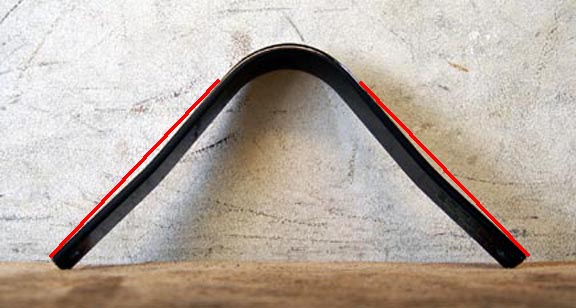
I'd handled those plates for years, but never really looked at them.  So I grabbed a plate, put it on my bench, and spent a few moments studying it;  Yes, there was definitely an inward kink about halfway down the leg of the Wintec plate ... and the lower part of the plate flared out ... This creates two different angles in the gullet plate - one above the kink, and one below it:


And when you compare these angles, they're quite different:


Now, when the gullet is installed in the saddle, the kink corresponds roughly with the top edge of the panels, so technically the lower part - which would be the tree point on a fixed-tree saddle - is one angle, and that angle should be parallel to your horse's back.  However, in my experience, this design creates the potential for a great deal of pressure right at the top of the panel.  On some horses, this doesn't seem to create issues, but on some - especially those for whom the panel placement isn't quite perfect - it does create a substantial spot of pressure ... and there's nothing that can be done to correct it.  And when I see the "straight leg" on other changeable gullet plates, and on the head plates of the fixed-tree saddles, I look at that inward kink and wonder "Why?"