Becoming a saddle fitter was a mid-life career change for me. I'd been an "at home mom" for about 5 years before I started working for Edie, and before that, I'd spent about 15 years making my living as a dressage trainer and instructor. And when I'm doing saddle fitting, I find that my trainer / instructor past is never far away. Many times, I have to keep myself from slipping back into the instructor's role if I see someone posting ahead of the motion or struggling with a transition or allowing the horse to lean on the inside aids. Having an eye for a rider's issues can be a help when choosing a saddle ... but old habits do die hard.
In the previous entry, Edie mentioned riders looking for a "miracle" saddle, and that's not as uncommon as many people would think. Our society's search for instant gratification is definitely manifest in the horse world - we want everything yesterday. We race Thoroughbreds that have just turned two years old; have 4 year old dressage horses that are showing First level and schooling Second; we start horses over fences at 3, show yearlings in longe line classes ... and want to find the magic saddle that automatically make our balance perfect, our seat independent and secure, our hands light and soft, and our aids perfectly timed and impeccably applied. (It's also supposed to turn our horses into Ahlerich or Giltedge or Abdullah or Rugged Lark ... but I won't get into that now.)
Here's the bottom line, people: there is no magic bullet. You must learn to ride, and ride well. I'm not talking about becoming professional or Olympic caliber; I understand the physical and mental limitations that we all face (yeah, even you young skinny types who bounce when you get dumped rather than just going "splat"). I mean doing your personal best and gaining a solid level of competence - becoming a rider instead of a passenger. I'll be the first to admit that the right saddle can really help your position and balance, and the wrong one can hinder the same, but there is no saddle out there that will make up for deficiencies in your riding. Deep seats, big calf blocks, grippy seat leather, padded flaps and steroidal thigh blocks will not turn an inexperienced (or - let's be blunt - lazy) rider into a competent, experienced rider. The only thing that will do that is practice ... and lots of it.
Why become competent? Besides the obvious - taking pride in the ability to ride well - there are two reasons: first, it's a lot easier on your horse. Anyone who's ever carried an unbalanced toddler on their back can empathize with a horse that has to carry an unbalanced rider. If you're consistently sitting heavily to one side, if your core muscles are lacking and you're unstable in the saddle, if you don't develop a soft, independent seat and hands, your horse - AND your horse's performance - will pay for it. You'll have a horse who's impossible to bend in one direction or the other, who drops behind or goes above the bit, who'll only pick up one lead, who'll duck out at fences, who'll go down the trail with his back hollow and his head in your face, who'll refuse to engage his haunches and work through his back ... I'm sure you get the idea. In order for your horse to develop correctly - or at least be comfortable - you must become a competent rider.
Second, it's easier on your saddle. I've seen "sided" riders who compress the flocking unevenly and stretch their stirrup leathers ... and that's just the tip of the iceburg. I've also seen sided riders stretch the panel and seat leather. I've seen riders who use an unholy amount of seat wear holes in or stretch the seat leather. I've seen riders twist saddle trees by constantly riding with one side further forward. I've seen tight legs warp or wear through flaps, I've seen riders who depend that "rider glue" - Sadl-Tite is one - compromise the finish of their leather, and in one memorable case, a rider whose dependence on "grippy" full seat breeches completely trashed the seat on her saddle - chewed all the way through to the foam - in about 3 years.
I guess it comes down to where you prefer to spend your money and time: in the saddle working to improve your riding ... or on the ground, with your vet and saddle fitter.
Tuesday, February 23, 2010

Thursday, February 4, 2010
From the Trainer's Perspective - Guest Post by Edie Tschorn
This is another in a series of rather infrequent guest blog posts by equine professionals who have another view of saddle fitting. This time, Edie Tschorn is my guest blogger. As many of you know, she owned Trumbull Mtn. Tack for over 30 years, and was my employer for about 10. I've known Edie since the late 1970s; she has been involved in training, breeding, showing, buying, selling, boarding, instructing, and retraining/rehabbing problem horses - and probably a few things I've neglected to mention. She's helped me resolve some issues with Lyric that had me beating my breast, banging my head and weeping. I have enormous respect for her experience, opinions and knowledge - and she can no longer claim that I'm saying that because she signs my pay checks. So here's something from her slant. Enjoy!
Friday, January 22, 2010
Thursday, January 14, 2010
In An Effort to Make Your Day a Bit More Surreal ...
I just got off the phone with one of those people who makes you go, "Now wait a minute here ..." My conversation with her made me feel (to misquote Steven King) as though I'd been in a pillow fight in which the pillows had been treated with a mild toxin.
CALLER: I need some advice on monoflap saddles.
ME: Sure, I'd be happy to help you. What would you like to know?
CALLER: I need some advice on monoflap saddles!
ME: Ok ... close contact, all-purpose or dressage?
CALLER: Close contact.
ME: Did you have any particular saddle in mind?
CALLER: No. I need advice on monoflap saddles!
ME: Ok, sure. What kind of horse are you trying to fit?
CALLER: A Belgian warmblood cross.
ME: A Belgian warmblood cross ... Just so I understand, are we talking about a Belgian warmblood crossed with something, or a Belgian draft horse crossed with a warmblood?
CALLER: A Belgian draft crossed with a Thoroughbred, of course.
ME: Ah ... Belgian-Thoroughbred. I see, thanks. Well, unless you want to consider a Black Country Vinici, most monoflap saddles aren't designed to fit the wider horses, so maybe -
CALLER: Belgian warmblood cross. He's a medium-wide.
ME: Ok, that's helpful. Medium-wide in what saddle?
CALLER: He's a medium-wide!
ME: Ok, fine, medium wide. Can you tell me a little about his conformation? Does he have a big wither, or is he more flat-backed? Does he -
CALLER: What does that matter? He's a ME-dium WIDE - I TOLD you that.
ME: Yes, right. Unfortunately, 'medium-wide' can vary from saddle to saddle, so without knowing a little about the way your horse is built, I can't really make much in the way of solid recommendations about saddles. If -
CALLER: I TOLD you- he's a MEdium-WIDE!!
ME: Yes, thanks, I understand. But width is only one factor here - we need to consider tree shape and panel configuration, too. Would it be possible to have you send a template of your horse's back and some photos? It's pretty hard to make any kind of meaningful recommendation -
CALLER: Look, do you want to help me, or not?
ME: Well, yes - yes, I do. Really. But without knowing more about your horse, I can't really tell you which monoflap saddles would be your best -
CALLER (sighing heavily): Ok. So just tell me about the Frank Baines.
ME: Sure. The Enigma.
CALLER (even bigger sigh): Well of COURSE the Enigma - do you have any OTHER Baines monoflap saddles?
ME: Not close contact, no. Well, the Enigma is a real jump-focus saddle - great cross-country saddle, and is designed -
CALLER: How does it fit the HORSE?!
ME: Those saddles are designed with the leaner, more Thoroughbred-type horse in mind. More like an eventer.
CALLER: What do you mean, "eventer"?
ME: Um, three-day eventers? Lean and rangy conformation ... often Thoroughbreds or Thoroughbred crosses, bigger wither and -
CALLER: The Vega?
ME: Again, the leaner Thoroughbred-type horse, I'm afraid.
CALLER: Well, what DO you have that might work for me?
ME (And I'm normally pretty easy-going where customers are concerned, but by this time I'll admit that I was thinking, Valium? Chloroform? Mace?): I'm really not trying to be obtuse, but -
CALLER: WHAT did you just say to me?!?
ME: I'm really not trying to be difficult here, honest - I do want to help you. But without knowing a little more about your horse, I'd be blowing smoke if I told you to try this saddle or that saddle. In order to really help you out, I have to know -
CLICK.
I guess I didn't have the info she wanted ...
Well, you know, some days are like that: it's just not worth chewing through the straps. Fortunately, most of the people I deal with are far more polite and far more forthcoming with details about their horse, and are more than happy to provide me with the information I need to make comprehensive recommendations about saddles that might actually fit. And honestly, I'm thinking maybe this person was one of those Secret Shoppers who get paid to be difficult. Who else would get anything out of acting like that?
CALLER: I need some advice on monoflap saddles.
ME: Sure, I'd be happy to help you. What would you like to know?
CALLER: I need some advice on monoflap saddles!
ME: Ok ... close contact, all-purpose or dressage?
CALLER: Close contact.
ME: Did you have any particular saddle in mind?
CALLER: No. I need advice on monoflap saddles!
ME: Ok, sure. What kind of horse are you trying to fit?
CALLER: A Belgian warmblood cross.
ME: A Belgian warmblood cross ... Just so I understand, are we talking about a Belgian warmblood crossed with something, or a Belgian draft horse crossed with a warmblood?
CALLER: A Belgian draft crossed with a Thoroughbred, of course.
ME: Ah ... Belgian-Thoroughbred. I see, thanks. Well, unless you want to consider a Black Country Vinici, most monoflap saddles aren't designed to fit the wider horses, so maybe -
CALLER: Belgian warmblood cross. He's a medium-wide.
ME: Ok, that's helpful. Medium-wide in what saddle?
CALLER: He's a medium-wide!
ME: Ok, fine, medium wide. Can you tell me a little about his conformation? Does he have a big wither, or is he more flat-backed? Does he -
CALLER: What does that matter? He's a ME-dium WIDE - I TOLD you that.
ME: Yes, right. Unfortunately, 'medium-wide' can vary from saddle to saddle, so without knowing a little about the way your horse is built, I can't really make much in the way of solid recommendations about saddles. If -
CALLER: I TOLD you- he's a MEdium-WIDE!!
ME: Yes, thanks, I understand. But width is only one factor here - we need to consider tree shape and panel configuration, too. Would it be possible to have you send a template of your horse's back and some photos? It's pretty hard to make any kind of meaningful recommendation -
CALLER: Look, do you want to help me, or not?
ME: Well, yes - yes, I do. Really. But without knowing more about your horse, I can't really tell you which monoflap saddles would be your best -
CALLER (sighing heavily): Ok. So just tell me about the Frank Baines.
ME: Sure. The Enigma.
CALLER (even bigger sigh): Well of COURSE the Enigma - do you have any OTHER Baines monoflap saddles?
ME: Not close contact, no. Well, the Enigma is a real jump-focus saddle - great cross-country saddle, and is designed -
CALLER: How does it fit the HORSE?!
ME: Those saddles are designed with the leaner, more Thoroughbred-type horse in mind. More like an eventer.
CALLER: What do you mean, "eventer"?
ME: Um, three-day eventers? Lean and rangy conformation ... often Thoroughbreds or Thoroughbred crosses, bigger wither and -
CALLER: The Vega?
ME: Again, the leaner Thoroughbred-type horse, I'm afraid.
CALLER: Well, what DO you have that might work for me?
ME (And I'm normally pretty easy-going where customers are concerned, but by this time I'll admit that I was thinking, Valium? Chloroform? Mace?): I'm really not trying to be obtuse, but -
CALLER: WHAT did you just say to me?!?
ME: I'm really not trying to be difficult here, honest - I do want to help you. But without knowing a little more about your horse, I'd be blowing smoke if I told you to try this saddle or that saddle. In order to really help you out, I have to know -
CLICK.
I guess I didn't have the info she wanted ...
Well, you know, some days are like that: it's just not worth chewing through the straps. Fortunately, most of the people I deal with are far more polite and far more forthcoming with details about their horse, and are more than happy to provide me with the information I need to make comprehensive recommendations about saddles that might actually fit. And honestly, I'm thinking maybe this person was one of those Secret Shoppers who get paid to be difficult. Who else would get anything out of acting like that?
Saturday, January 2, 2010
And Here's to You, Sara Ineson ...
The new year is bringing some changes at the shop: Sara Ineson left us at the close of '09 to pursue some new challenges. She started at with Edie in 1996, bringing extensive retail experience from her years in the ski industry. In addition to being our hunter/jumper and eventing specialist, Sara was our buyer, staying on top of inventory and trends, and doing the ordering.
Sara was also The Organizer. Whether she was displaying bridles (hung to Pony Club specs, thank you very much), running sales reports or setting the target time for the annual hunter pace, Sara not only had all the ducks in a row - she made sure they were organized by height, marching in step, all in the same direction, with their bills spit-shined and their feathers in fine trim.
So we all wanted to say a little something about the years we've worked with Sara. And since it's my blog, I get to go first:
I've known Sara since high school, when she used to terrify me at local horse shows by burning up the course in the jumper classes. (I can remember watching her and her horse Forté during one jump-off, clearing fences at about Mach 4, and thinking, "Ohmygod, they're gonna die, they're gonna die" - which, obviously, they didn't.) She taught me a ton about the world of forward-seat riding, showing me the differences between an equitation-focus saddle and a jump-focus saddle, educating me about proper hunt turn-out and explaining the intricacies of Three-Day eventing. She's a great teacher and friend; I'm going to miss her practical, no-nonsense take on things. I'm glad that she's going to be keeping her mare Hobette here at the farm so we can continue to have our barn aisle conversations about gardening, photography and the State of Horses and Saddle Fitting.
From Edie:
We bid a very fond farewell and good luck to Sara Ineson who has been with the shop through its formative years, and has dealt brilliantly with two entire computer systems. Sara's knowledge of retail is tremendous and I give her a lot of credit in the success of our business. Sara's horse, "Hobette" will continue to reside at the farm, so we will have the good fortune to be able to access Sara's saddle fitting knowledge from over the paddock fence for some of the tougher cases! Good luck to you, Sara, and thank you so much for years and years of hard work.
From Nancy:
Sara and I have worked together for 11 years and together we have watched the shop grow into a "Force to be Reckoned with" (as we've been called!) and I will truly miss her and what she brings to the Tack Shop. We sort of fill in each other's missing pieces. Sara is very detail oriented and great with numbers. I see a customer's sales record and my eyes cross and glaze. Yet, we both go that extra mile for our customers and work together on many saddle orders to make sure it's the perfect fit. I've grown to rely on her knowledge and competency. She is my friend and we have shared so much of our lives over the years. I wish her much joy and love in the next phase of her life.
Sara was also The Organizer. Whether she was displaying bridles (hung to Pony Club specs, thank you very much), running sales reports or setting the target time for the annual hunter pace, Sara not only had all the ducks in a row - she made sure they were organized by height, marching in step, all in the same direction, with their bills spit-shined and their feathers in fine trim.
So we all wanted to say a little something about the years we've worked with Sara. And since it's my blog, I get to go first:
I've known Sara since high school, when she used to terrify me at local horse shows by burning up the course in the jumper classes. (I can remember watching her and her horse Forté during one jump-off, clearing fences at about Mach 4, and thinking, "Ohmygod, they're gonna die, they're gonna die" - which, obviously, they didn't.) She taught me a ton about the world of forward-seat riding, showing me the differences between an equitation-focus saddle and a jump-focus saddle, educating me about proper hunt turn-out and explaining the intricacies of Three-Day eventing. She's a great teacher and friend; I'm going to miss her practical, no-nonsense take on things. I'm glad that she's going to be keeping her mare Hobette here at the farm so we can continue to have our barn aisle conversations about gardening, photography and the State of Horses and Saddle Fitting.
From Edie:
We bid a very fond farewell and good luck to Sara Ineson who has been with the shop through its formative years, and has dealt brilliantly with two entire computer systems. Sara's knowledge of retail is tremendous and I give her a lot of credit in the success of our business. Sara's horse, "Hobette" will continue to reside at the farm, so we will have the good fortune to be able to access Sara's saddle fitting knowledge from over the paddock fence for some of the tougher cases! Good luck to you, Sara, and thank you so much for years and years of hard work.
From Nancy:
Sara and I have worked together for 11 years and together we have watched the shop grow into a "Force to be Reckoned with" (as we've been called!) and I will truly miss her and what she brings to the Tack Shop. We sort of fill in each other's missing pieces. Sara is very detail oriented and great with numbers. I see a customer's sales record and my eyes cross and glaze. Yet, we both go that extra mile for our customers and work together on many saddle orders to make sure it's the perfect fit. I've grown to rely on her knowledge and competency. She is my friend and we have shared so much of our lives over the years. I wish her much joy and love in the next phase of her life.
Friday, December 18, 2009
Cause and Symptom
"I'll remove the cause, but not the symptom."
- Dr. Frank N. Furter, Rocky Horror Picture Show
- Dr. Frank N. Furter, Rocky Horror Picture Show
Monday, December 14, 2009
Eenie, Meenie, Miney, Mo (Choosing a Saddler/Fitter)
One of the most constant pieces of advice I seem to give people is, "Find a reputable fitter in your area, and have them come out and take a look/do the adjustment/give you some input." Hands-on fitting is the optimal way to go - you can do a fitting assessment or see many adjustments that need to be made via photos, and bumping a saddle back up to factory spec is pretty simple - but particularly for more complex fitting issues, having a knowledgeable fitter there in person is the best way to insure correct fit.
I have dispensed this advice for as long as I've been fitting saddles, and I think it's pretty darn sound advice ... but someone recently threw me a curve. "What I want to know, " this person asked, "is how to find someone who knows their stuff? And how do I know that they know their stuff?"
And that, dear readers, is a damn good question.
First, merely finding a fitter can be a fairly daunting task. We're really pretty thin on the ground. There are lists of fitters on the Society of Master Saddlers' website here, and on the Master Saddlers Association website here; some saddle companies list their fitters on their web sites, or their reps / retailers are fitters. And I'm after Mike Scott to put a list of his fitting course's graduates on his web site, too. But as I've written before (in "For the First-Time Horse Owner" wa-a-a-a-a-y back in Jan.), not all certified fitters are good, and not all good fitters are certified. Certification is only as good as the organization offering it - some courses are outstanding, and some are little more than "how to sell our saddle" tutorials aimed at a company's reps. Of course, so much depends on how the individual fitter uses the education offered - you can put forth the best, most comprehensive information available, but how and if someone assimilates and applies the knowledge is key.
So, if certification isn't really a reliable measure, how do you find a good fitter? In my experience, word of mouth is a pretty good indicator. Check with veterinarians, with chiropractors, massage therapists, tack shop and barn owners, and other riders. Most people are more than happy to share their opinions. If the overwhelming majority of people like or dislike someone, there's usually a pretty good reason. I know some outstanding saddlers/fitters whose only certification comes from years of successful business and glowing recommendations from their customers, and I know some fitters who have multiple certifications and not much in the way of street cred. The reverse is true, too.
Another thing to consider is your gut reaction. No matter how highly recommended a fitter is, if there's something about him/her that you just don't like (even if it's something as basic as the attitude with which they walk into the barn), it may not be a good mix. Personality does come into the mix with fitters, as it does with your trainer, vet or farrier. I'm not saying you'll always agree with everything a fitter says, and s/he may make some suggestions that seem a little unusual (I've had times when clients have looked at me as though I'd grown another head), but if the overall feeling isn't a good one, you might want to consider it a learning experience and just move on to someone else.
In addition to reputation and personality, here's a list of things that I think are important to consider when you're choosing a fitter:
1) Does the fitter listen to my input? Does s/he take time to get a history of the saddles I've tried, and the fitting issues my horse and I have encountered?
2) Does the fitter ask if my horse is or has been experiencing any soundness issues?
3) Does the fitter pay attention to my horse's reaction?
4) Is the fitter willing to see if my existing saddle can be made to work, or is s/he immediately telling me I need a new one?
5) If I do need (or want) a new saddle, what options is the fitter offering? Am I being pushed toward only one brand, or am I being given a choice?
6) If I'm trying a new saddle but don't feel comfortable in it, or feel it's not fitting my horse well, does the fitter take that into consideration?
7) (And this is my biggest peeve.) Is the fitter telling me that the XYZ saddle company makes a saddle that will suit every horse and rider in the world?
As I said before, you won't get on with every fitter out there, and you may have to go through a bit of trial-and-error. But if you can find someone who'll listen to you and take the time to make sure that you and your horse are comfortable and happy, it will be worth the search.
I have dispensed this advice for as long as I've been fitting saddles, and I think it's pretty darn sound advice ... but someone recently threw me a curve. "What I want to know, " this person asked, "is how to find someone who knows their stuff? And how do I know that they know their stuff?"
And that, dear readers, is a damn good question.
First, merely finding a fitter can be a fairly daunting task. We're really pretty thin on the ground. There are lists of fitters on the Society of Master Saddlers' website here, and on the Master Saddlers Association website here; some saddle companies list their fitters on their web sites, or their reps / retailers are fitters. And I'm after Mike Scott to put a list of his fitting course's graduates on his web site, too. But as I've written before (in "For the First-Time Horse Owner" wa-a-a-a-a-y back in Jan.), not all certified fitters are good, and not all good fitters are certified. Certification is only as good as the organization offering it - some courses are outstanding, and some are little more than "how to sell our saddle" tutorials aimed at a company's reps. Of course, so much depends on how the individual fitter uses the education offered - you can put forth the best, most comprehensive information available, but how and if someone assimilates and applies the knowledge is key.
So, if certification isn't really a reliable measure, how do you find a good fitter? In my experience, word of mouth is a pretty good indicator. Check with veterinarians, with chiropractors, massage therapists, tack shop and barn owners, and other riders. Most people are more than happy to share their opinions. If the overwhelming majority of people like or dislike someone, there's usually a pretty good reason. I know some outstanding saddlers/fitters whose only certification comes from years of successful business and glowing recommendations from their customers, and I know some fitters who have multiple certifications and not much in the way of street cred. The reverse is true, too.
Another thing to consider is your gut reaction. No matter how highly recommended a fitter is, if there's something about him/her that you just don't like (even if it's something as basic as the attitude with which they walk into the barn), it may not be a good mix. Personality does come into the mix with fitters, as it does with your trainer, vet or farrier. I'm not saying you'll always agree with everything a fitter says, and s/he may make some suggestions that seem a little unusual (I've had times when clients have looked at me as though I'd grown another head), but if the overall feeling isn't a good one, you might want to consider it a learning experience and just move on to someone else.
In addition to reputation and personality, here's a list of things that I think are important to consider when you're choosing a fitter:
1) Does the fitter listen to my input? Does s/he take time to get a history of the saddles I've tried, and the fitting issues my horse and I have encountered?
2) Does the fitter ask if my horse is or has been experiencing any soundness issues?
3) Does the fitter pay attention to my horse's reaction?
4) Is the fitter willing to see if my existing saddle can be made to work, or is s/he immediately telling me I need a new one?
5) If I do need (or want) a new saddle, what options is the fitter offering? Am I being pushed toward only one brand, or am I being given a choice?
6) If I'm trying a new saddle but don't feel comfortable in it, or feel it's not fitting my horse well, does the fitter take that into consideration?
7) (And this is my biggest peeve.) Is the fitter telling me that the XYZ saddle company makes a saddle that will suit every horse and rider in the world?
As I said before, you won't get on with every fitter out there, and you may have to go through a bit of trial-and-error. But if you can find someone who'll listen to you and take the time to make sure that you and your horse are comfortable and happy, it will be worth the search.
Friday, December 4, 2009
But It Doesn't FIT!
While we're talking about saddle construction, we're going to take a small side-trip here. This issue is one that just showed up on my radar recently, and I suppose I could save it for later, but I'm finding that writing while the idea is fresh usually results in a better entry.
I'm once again tapping into a subject I found on one of the bigger bulletin boards. It's a tale of woe, of anticipation and longing and a wish that didn't come true - and it's a tale that could have had a reasonably happy (or at least not totally tragic) ending ... but didn't.
Someone (let's be really original and call her "someone") ordered a saddle for her horse - had the fitter out, had the measurements done, ordered the deluxe fancy leather / air panels / contrasting seat welting / bells and whistles Princess version once-in-a-lifetime saddle ... really shot the wad to the tune of about $5000.
Fast forward about 6 months, to the arrival of the long anticipated saddle. Not only was the saddle conspicuously minus many of the bells and whistles and Princess accessories "someone" had ordered ... it did not fit.
This is a pretty sad story in and of itself. But wait, it gets sadder: according to "someone", the fitter adjusted flocking, adjusted the seat, and did everything but stand on his/her head and whistle a tune while drinking cider through a straw ... and the fitter could not make the saddle fit.
Sadder yet: the fitter then tried to blame the bad fit on "someone" (even went so far as to infer that "someone" had packed on some poundage) and her horse.
The denouement? No refund. Too bad, so sad, but the saddle was "someone's" ... lacking bells, whistles and Princess accessories, AND not fitting either horse or rider. Eventually, "someone" did get the fitter to take the saddle back, but was still charged a 20% restocking fee (which, as any mathmatically gifted person can tell you, comes to a cool $1000).
Admittedly, I only have "someone's" side of this whole story ... but I gotta think, if "someone" is upset enough to air this whole experience on one of the major equine bulletin boards, something had to have gone wrong - and probably quite drastically so. So, while we may never know just who fell down, or where, here are some possibilities:
1) The Saddler Messed Up. It does happen - I mean, we're talking about a hand-crafted item here, and as statistician Marge N. Uverror will tell you, human beings are fallible. But usually, if the saddler messes up, it's only one thing - sometimes one very big thing, like the wrong color or the wrong tree - but it's rare that the whole saddle is a fiasco. In the roughly 10 years we've been ordering saddles to template, we've only had a handful of "mistakes" come through. And each time, the saddle company has stepped up and made things right.
2) The Fitter Messed Up. This happens, too - again, human fallibility. And to be brutally honest, the fitter probably messes up more frequently than the saddler. Fitters are out there taking templates and photos, measuring the rider, writing orders, noting modifications ... basically getting all the bells and whistles and Princess accessory details correct. And if a fitter is really busy, has customers stacked up, has an uncooperative horse (or owner ... yes, they do exist) ... it's not that hard to mismark or skip over something. I bust my butt to make sure the template and photos are correct - I'll do a tracing over (and over, and over) if I think something may be inaccurate. And still, I've screwed up. Not very often, and not recently ... but I have before and I'd be foolish to think I won't again. And when that happens, we step up and make things right.
3) The Horse Went and Changed. As I addressed long ago in the "Timing is Everything" post, horses can change quite radically in a fairly short period, particularly if it a youngster advancing quickly in training, a horse changing disciplines, or a seasoned campaigner coming back from a lay-up. To illustrate, I'm re-posting the photos that went with the "Timing is Everything" entry. This template, of a horse that was coming back into work after a month's lay-off, was taken in Oct. of '08:

Now, here's a template of the same horse taken in March of '09, after about four and a half months of gentle long-and-low work:

And here's a comparison of the two, with the '08 template in red, and the '09 in green:

That's a pretty dramatic difference. The saddle ordered to the back in the first template no longer fit the back in the second template ... but in this case, instead of being a bad fit from the get-go, the horse "grew out of it" gradually, and after the tree was widened and the flocking adjusted, the fit was fine.
4) The Owner is an Unreasonable Lunatic. Again, this is not completely unknown ... but it's very, very rare. Most people are really quite reasonable, and usually, if the customer is unhappy, there's a reason. And if someone has gone to the bother and expense of ordering a custom (or bench-made) saddle, it's hardly unreasonable for them to expect that it will be to spec, and it will fit.
In any or all of these cases, the best business practice (and the only one that will let me sleep at night) is to take the saddle back. It happens very infrequently - I'd say that over 90% of our bench-made (or custom, or semi-custom ... choose your term) saddles come as ordered and fit well - but it does happen. What's the sense in trying to make a customer keep a saddle that doesn't fit and makes them (and their horse) unhappy? Sure, you may make that one sale, but at some point, "someone" will be willing to step up and tell the world about their experience - and they will be well within their rights to do so. Word of mouth is one of the most powerful forms of advertising, for better or for worse ... and frankly, that's the sort of press I can live very well without.
I'm once again tapping into a subject I found on one of the bigger bulletin boards. It's a tale of woe, of anticipation and longing and a wish that didn't come true - and it's a tale that could have had a reasonably happy (or at least not totally tragic) ending ... but didn't.
Someone (let's be really original and call her "someone") ordered a saddle for her horse - had the fitter out, had the measurements done, ordered the deluxe fancy leather / air panels / contrasting seat welting / bells and whistles Princess version once-in-a-lifetime saddle ... really shot the wad to the tune of about $5000.
Fast forward about 6 months, to the arrival of the long anticipated saddle. Not only was the saddle conspicuously minus many of the bells and whistles and Princess accessories "someone" had ordered ... it did not fit.
This is a pretty sad story in and of itself. But wait, it gets sadder: according to "someone", the fitter adjusted flocking, adjusted the seat, and did everything but stand on his/her head and whistle a tune while drinking cider through a straw ... and the fitter could not make the saddle fit.
Sadder yet: the fitter then tried to blame the bad fit on "someone" (even went so far as to infer that "someone" had packed on some poundage) and her horse.
The denouement? No refund. Too bad, so sad, but the saddle was "someone's" ... lacking bells, whistles and Princess accessories, AND not fitting either horse or rider. Eventually, "someone" did get the fitter to take the saddle back, but was still charged a 20% restocking fee (which, as any mathmatically gifted person can tell you, comes to a cool $1000).
Admittedly, I only have "someone's" side of this whole story ... but I gotta think, if "someone" is upset enough to air this whole experience on one of the major equine bulletin boards, something had to have gone wrong - and probably quite drastically so. So, while we may never know just who fell down, or where, here are some possibilities:
1) The Saddler Messed Up. It does happen - I mean, we're talking about a hand-crafted item here, and as statistician Marge N. Uverror will tell you, human beings are fallible. But usually, if the saddler messes up, it's only one thing - sometimes one very big thing, like the wrong color or the wrong tree - but it's rare that the whole saddle is a fiasco. In the roughly 10 years we've been ordering saddles to template, we've only had a handful of "mistakes" come through. And each time, the saddle company has stepped up and made things right.
2) The Fitter Messed Up. This happens, too - again, human fallibility. And to be brutally honest, the fitter probably messes up more frequently than the saddler. Fitters are out there taking templates and photos, measuring the rider, writing orders, noting modifications ... basically getting all the bells and whistles and Princess accessory details correct. And if a fitter is really busy, has customers stacked up, has an uncooperative horse (or owner ... yes, they do exist) ... it's not that hard to mismark or skip over something. I bust my butt to make sure the template and photos are correct - I'll do a tracing over (and over, and over) if I think something may be inaccurate. And still, I've screwed up. Not very often, and not recently ... but I have before and I'd be foolish to think I won't again. And when that happens, we step up and make things right.
3) The Horse Went and Changed. As I addressed long ago in the "Timing is Everything" post, horses can change quite radically in a fairly short period, particularly if it a youngster advancing quickly in training, a horse changing disciplines, or a seasoned campaigner coming back from a lay-up. To illustrate, I'm re-posting the photos that went with the "Timing is Everything" entry. This template, of a horse that was coming back into work after a month's lay-off, was taken in Oct. of '08:

Now, here's a template of the same horse taken in March of '09, after about four and a half months of gentle long-and-low work:

And here's a comparison of the two, with the '08 template in red, and the '09 in green:

That's a pretty dramatic difference. The saddle ordered to the back in the first template no longer fit the back in the second template ... but in this case, instead of being a bad fit from the get-go, the horse "grew out of it" gradually, and after the tree was widened and the flocking adjusted, the fit was fine.
4) The Owner is an Unreasonable Lunatic. Again, this is not completely unknown ... but it's very, very rare. Most people are really quite reasonable, and usually, if the customer is unhappy, there's a reason. And if someone has gone to the bother and expense of ordering a custom (or bench-made) saddle, it's hardly unreasonable for them to expect that it will be to spec, and it will fit.
In any or all of these cases, the best business practice (and the only one that will let me sleep at night) is to take the saddle back. It happens very infrequently - I'd say that over 90% of our bench-made (or custom, or semi-custom ... choose your term) saddles come as ordered and fit well - but it does happen. What's the sense in trying to make a customer keep a saddle that doesn't fit and makes them (and their horse) unhappy? Sure, you may make that one sale, but at some point, "someone" will be willing to step up and tell the world about their experience - and they will be well within their rights to do so. Word of mouth is one of the most powerful forms of advertising, for better or for worse ... and frankly, that's the sort of press I can live very well without.
Tuesday, November 24, 2009
"Like a Box of Chocolates" Part II - All the Pretty Flocking
And sometimes, things start out so very, very run-of-the-mill, just-another-day-at-the-bench ...
About a week ago, I received an older Theo Sommer all-purpose saddle for a strip flock and C&C (cleaning and conditioning all the nooks and crannies while I have the saddle apart). The saddle showed its age somewhat (turns out it's about 23 years old); the leather was a bit fragile and the flocking was relatively lumpy, but it had been meticulously maintained and the entire C&C took less time than scrubbing the dirt jockeys off the flaps of some saddles I've worked on ... Anyway, this saddle was so spectacularly unspectacular that I didn't even take photos ... until I started removing the flocking.
I dropped the panels and stuck my hook in one of the flocking holes, and pulled out:

Crimson, navy and lavender, oh my!
I've pulled some multi-colored wool out of some old Stubbens and Passiers (much of the wool used "back in the day" in these saddles was remnant stuff from the garment and upholstery industries, so the mix was quite colorful and sometimes even included some metallic stuff), but large masses of solid, bright colors was something entirely new. So I kept pulling:


And pulling:

Yes, that IS yarn mixed in there. And curiosity led me to do the fire test to find out if it was wool or synthetic. When I touched the flame to the end of one piece, it went up as though it had been soaked in gasoline - almost scorched my fingers - and had that "Burning Barbies" stench. DEFINITELY synthetic!

And pulling:
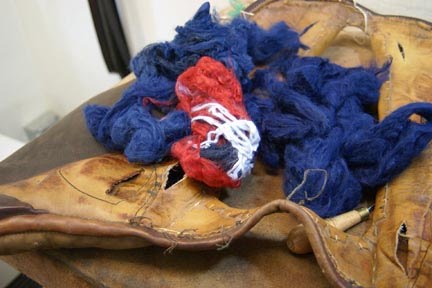
The saddle showed no signs of having been worked on before, so I'm guessing that this is the original flocking. While I've never heard of using yarn and would not have thought it worth much as flocking, I have to say that the panels were no lumpier than I'd have expected if the saddle had been flocked with plain old wool (particularly given the age of the saddle and the use it had obviously seen).
It's going to be a long time before I'm once again blasé about what I might find when I do a strip flock ...
Wednesday, November 4, 2009
From the Tree Up: Sub-topic - Adjustable Trees and Changeable Gullets
PREFACE
Please note that this post is not intended to bash, slander, bad-mouth, short-sell or otherwise denegrate saddles with adjustable trees or changeable gullets. When used as intended, they can fill spots that other saddles don't, and - in some cases - offer far better quality than fixed-tree saddles costing about the same. Lately, however, I've been running into quite a few folks who have some rather serious misperceptions about these saddles, and I'd like to make an effort to correct them.
Tuesday, October 27, 2009
From The Tree Up - Panels (the Basics)
After you've looked at tree width, scoop and type, the next consideration would be the panels. In this entry, I'm going to cover the basics, and explain panel modifications (and the conformations that need them) in a later post.
Basically, there are two main types of panels: gusseted (which are almost always wool-flocked):

and plain panels (which are often but not always foam flocked):


 Again, the angles are far better, and you'd have panel contact over the entire surface.
Final word about panel basics: adequate clearance in the channel. The saddles shown above offer generous clearance for the spine, which will keep the rider's weight from resting on the spinous process. And while you don't want to get too much clearance (too wide a channel will result in lateral instability), you certainly don't want to go to the other extreme, either:

Basically, there are two main types of panels: gusseted (which are almost always wool-flocked):

and plain panels (which are often but not always foam flocked):

The function of the gusset is to flatten and broaden the weight bearing surface in the rear of the panel. This is a good thing for a broad-backed horse, but often not such a great thing for a roof-backed horse. To illustrate, here's a photo of a broad-backed horse and non-gusseted panels:

The angle of the back is marked in green, and the angle of the panels is in red. You'll notice that when the saddle is placed on the horse's back, the outer edge of the panel will make contact, while the inner edge will bear little to no weight. Yes, it will squish down some when the rider's up, but not much, and the rider's weight will be concentrated in a fairly small area on the outer edge of the panel rather than being distributed over the whole surface.
Now, here' the same horse with a gusseted, flatter panel:

As you can see, the angles are much more agreeable with the gusseted panel, and there will be contact all along the weight bearing surface.
Now, to the other side of the fence. Here's a roof-shaped back with a flat, gusseted panel:

In this case, the bulk of the weight will be borne on the inside of the panels, along the channel close to the spine, while the outer edges of the panels bear little to no weight.
Here's that same back with that more angled panel:

Final word about panel basics: adequate clearance in the channel. The saddles shown above offer generous clearance for the spine, which will keep the rider's weight from resting on the spinous process. And while you don't want to get too much clearance (too wide a channel will result in lateral instability), you certainly don't want to go to the other extreme, either:

This saddle wouldn't even offer clearance for the skinny end of a 2"x4" ... NOT something I'd recommend using on a horse.
Next up: panel modifications, and the horses who need 'em.
Friday, October 23, 2009
From the Tree Up - Hoop Vs. Standard
The previous "From the Tree Up" entry discussed tree scoop, or the longitudinal curve (also called "sweep"). Now we're going to limit the discussion to the front of the tree - the gullet and pommel arch - and discuss the importance of finding the correct type of tree. The standard tree is shaped sort of like an inverted "V", or a peak/gabled roof:


 If you have what I refer to as a "table backed" horse, you might need a hoop tree:

Heh. Fun with PhotoShop. I sent it to Edie as a joke, and she thought it was pretty darn amusing, and had our web mistress put it on the web site ...
Here's what I really mean:
 Now, THAT is a table-back. Here it is with a standard w-i-d-e tree:


The shape of the gullet is like so:

This shape works many horses with "average" conformation (if such a term can be applied). Even if you have a really wide "average" horse, a standard tree could work:

The hoop tree is more like an inverted "U", or a gambrel roof (and in some extreme cases, think Quonset hut):

With a hoop tree, the gullet is shaped so:


Heh. Fun with PhotoShop. I sent it to Edie as a joke, and she thought it was pretty darn amusing, and had our web mistress put it on the web site ...
Here's what I really mean:


The shape isn't quite right. The orange arrows show where there would be areas of concentrated pressure, which would wind up making the horse sore.
Here's the same back with a hoop tree. Note that it follows the shape of the horse's back much better.

Now, let's take it to the other end of the spectrum. Here's a more "roof" shaped back:

If you try to put a hoop tree on this horse, note how low the saddle would sit, and how all the pressure would be concentrated on the ends of the tree points (provided it didn't bang into the wither first):

Same horse, standard gullet shape. The weight is distributed the entire length of the tree points:

Next up: Panel Configuration.
Subscribe to:
Posts (Atom)